Centric relation is the reference position you need whenever a restoration cannot simply copy the patient's existing bite. Recording it reliably is a technique skill, and an anterior jig is one of the simplest tools to make it repeatable. This article explains when to register centric relation rather than the intercuspal position, what the evidence shows for Lucia jigs and leaf gauges, and how to use a jig chairside, from deprogramming to protecting the bite during posterior preparations.
What centric relation means in practice
The Glossary of Prosthodontic Terms (GPT-9) defines centric relation as a maxillomandibular relationship that is independent of tooth contact, with the condyles articulating in an anterior-superior position against the posterior slopes of the articular eminences. Maximal intercuspal position (MIP, also called intercuspal position or, loosely, centric occlusion) is the opposite kind of reference: it is defined by the teeth.
The distinction matters because the two positions rarely coincide exactly. When a deprogramming jig was used before recording centric relation in 40 subjects, overbite decreased by a mean of 2.23 mm relative to maximum intercuspation, compared with 1.58 mm for a record without the jig (Karl and Foley 1999). A restoration made in one position and seated in the other will be high.
Conformative or reorganised: choosing the reference
UK guidance on good occlusal practice frames the decision simply. In most patients the existing occlusion is functional and comfortable, so restorations should conform to it: treatment stays within the existing envelope of static and dynamic relationships. Only when that is not possible is a reorganised approach, built in a new and reproducible jaw relation, appropriate (Davies et al. 2001).
| Situation | Reference | Approach |
|---|---|---|
| Single crown or short bridge, stable occlusion, no symptoms | intercuspal position | conformative; jig as a safeguard |
| Several posterior teeth prepared, existing bite to be kept | intercuspal position | conformative; jig placed before the first preparation |
| Full mouth rehabilitation, increased vertical dimension, change of mandibular position | centric relation | reorganised; trial with splint or provisionals |
| Occlusal splint fabrication | centric relation | record with jig or leaf gauge at the planned opening |
The intercuspal position can be a precise reference. In an intraoral-scanner study, 15 fully dentate participants found their habitual intercuspation again with a mean deviation of 42 ± 34 µm, regardless of time of day or upright versus supine posture, whereas repositioning stone casts deviated by a mean of 135 ± 77 µm (Jaschouz and Mehl 2014).
Lucia jig, leaf gauge and deprogrammers
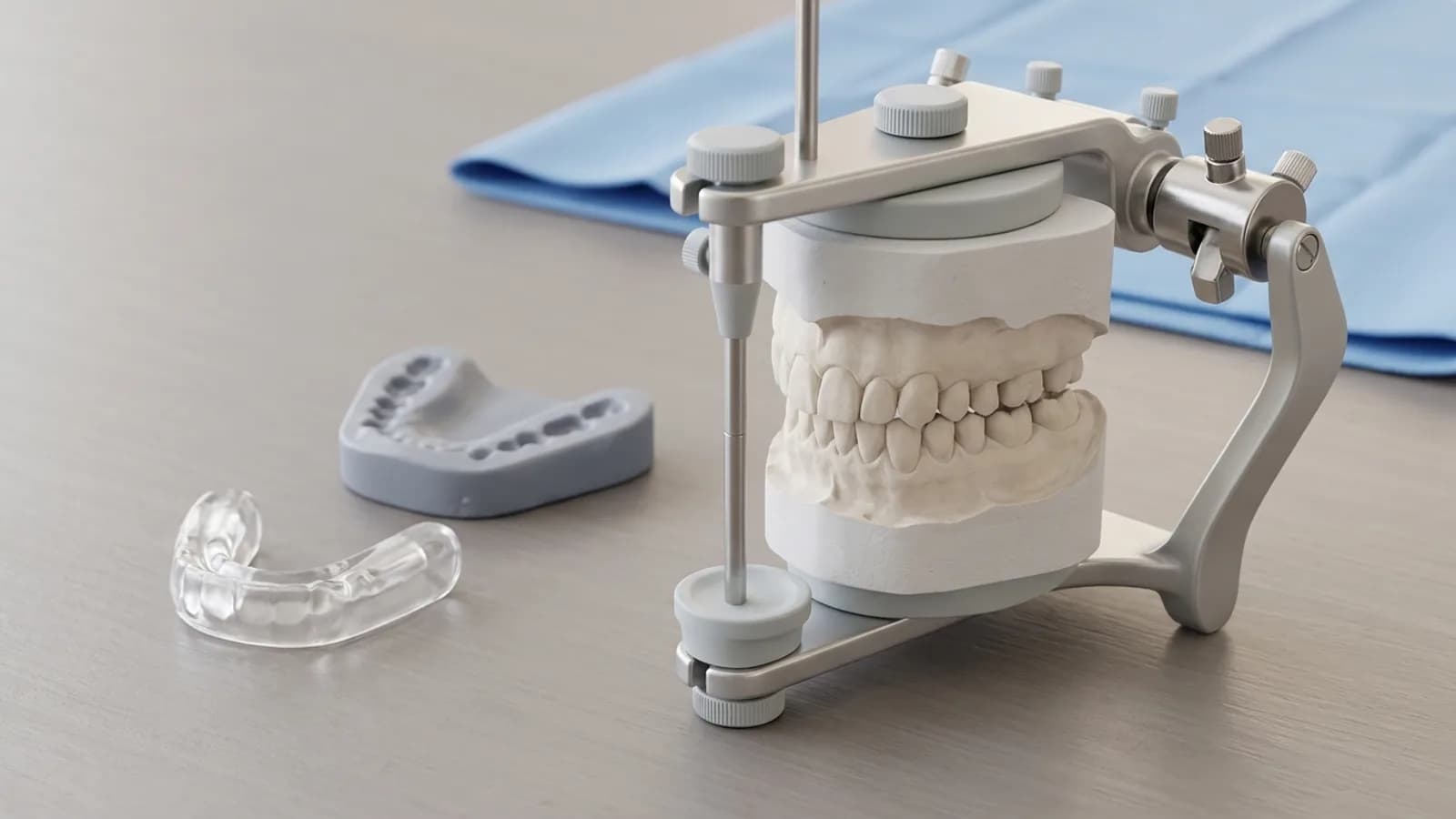
An anterior jig is a small resin stop on which the lower incisors contact while the posterior teeth are separated. Lucia described the technique in 1964; Long added the leaf gauge in 1973, a stack of thin plastic leaves whose number sets the amount of opening. Commercial anterior deprogrammers follow the same principle.
What does the jig achieve?
- Deprogramming. With no posterior contact, the cusps no longer guide the mandible into its habitual position. In a small pilot study (5 participants), clenching on a leaf gauge or jig reduced anterior temporalis activity compared with clenching in maximal intercuspation, without consistent condylar displacement (Santosa et al. 2006).
- Easier manipulation. Karl and Foley recommend the jig particularly for patients whose mandible is difficult to guide.
- A stable anterior stop. During posterior preparation the jig holds the existing vertical and horizontal relation even after the posterior stops have been removed.
Technique matters more than the device. Comparing three methods in 14 volunteers, bimanual manipulation with a jig gave the most repeatable condylar position and Gothic arch tracing the least (Keshvad and Winstanley 2003). McKee (1997) showed that dentists trained in a standardised bimanual technique repeated condylar position within the 0.11 mm tolerance of the measuring instrument, while a control group using their own methods did not.
Hands-on dental courses
Courses for dentists in Munich, several of them taught in English.
See all coursesMaterials: rigid, not elastic
Jigs and interocclusal records should be made from a hard, non-elastic material that stays dimensionally stable in thin sections and can be trimmed. Elastic silicone records can compress when the casts are seated. Bis-acrylate registration materials such as LuxaBite (DMG) are described by the manufacturer as reaching a very high final hardness, so they do not compress during repositioning, and as thixotropic, so they do not flow into embrasures. The material is mixed in an automix tip and applied directly (DMG, LuxaBite instructions for use).
Centric relation record with an anterior jig: protocol
- Make or adjust the jig so that only the lower incisors touch it, ideally as a point contact on a flat surface, with the posterior teeth just out of contact.
- Seat the patient upright with a neutral head posture. Head posture changes occlusal contacts measurably (Haralur et al. 2014).
- Deprogramme: the patient closes lightly on the jig several times, without posterior contact.
- Guide the mandible with a standardised technique, for example bimanual manipulation, without forcing it backwards.
- With the jig holding the position, inject rigid registration material bilaterally between the posterior teeth.
- Take a second record the same way and compare both on the casts. If they disagree, the position has not been captured reproducibly.
Set the opening by the goal: as little as possible for a restoration at the existing vertical dimension, or at the planned height for a splint or an increase in vertical dimension. How to decide that height is covered in vertical dimension of occlusion.
Keeping the bite during posterior preparations
The same device serves a different purpose in conformative treatment: preserving the existing intercuspal position while posterior teeth are prepared.
To make a chairside jig in the intercuspal position:
- Isolate the palatal surfaces of the upper incisors with a thin layer of petroleum jelly or a similar ointment.
- Dry the labial surfaces of the lower incisors.
- Apply bis-acrylate registration material to the lower incisors.
- Ask the patient to close into maximal intercuspation.
- Clear the incisal edges while the material is still plastic, so tooth position stays visible.
- Let it set, then ask the patient to open. For LuxaBite, DMG's instructions for use give a working time of 45 s from the start of mixing and, for a bite record, 45 to 60 s of intraoral setting followed, after a brief open-and-close, by a further 90 s.
- Trim and smooth the edges and check that the jig reseats without rocking.
A typical sequence for crowns on 15 to 17 (FDI; 4 to 2 in Universal notation):
- Make the jig before any preparation and scan the opposing arch with the jig in place.
- Prepare 15 and 16, leaving 17 unprepared as a posterior stop.
- Take a rigid record with the jig in place and a bite-registration scan.
- Prepare 17 and register again with the jig.
- Adjust the provisionals with the jig in place and remove the jig only at the very end.
At the fit appointment, check the record from the preparation visit first. A new jig made before the provisionals come off helps to set the occlusion of the definitive restorations tooth by tooth. If a rigid check record from the preparation visit fits but the crown is still high, look at casts, mounting or fabrication rather than the patient.
Common errors in jaw registration
- Local anaesthesia removes sensory feedback from the anaesthetised area, so patients cannot reliably feel whether they are closing as usual. Register before anaesthesia where possible, or use the jig made beforehand as the reference.
- Wide opening flexes the mandible. Gates and Nicholls (1981) found that maximal opening and protrusion change mandibular arch width and recommended avoiding protrusion and opening beyond 20 mm during impressions. Take buccal scans with the teeth fully closed and arch scans with moderate opening.
- Head posture in a reclined chair changes contacts; register with the patient upright (Haralur et al. 2014).
- Residues of provisional material on the teeth distort the record, so register before making the provisionals.
- Debris on the record: inspect both sides before seating the casts. Control notches show whether the record seats without a gap.
- Untrimmed records: reduce the record to the occlusal contact areas, as the LuxaBite instructions for use also specify; septa and fissure detail left in place prevent unambiguous seating.
Summary
Use the intercuspal position as the reference whenever a conformative approach is possible, and protect it with an anterior jig during posterior preparation. Record centric relation when the occlusion has to be reorganised, as in an occlusal splint, an increase in vertical dimension or full mouth rehabilitation of the worn dentition, and use a standardised, repeatable technique. The resulting occlusal scheme, including anterior guidance, is discussed in canine guidance and the occlusion concept. Jig and leaf-gauge registration are practised hands-on in our VDO and occlusion training course for dentists.
Frequently asked questions
What is the difference between centric relation and centric occlusion?
Centric relation is a jaw relationship independent of tooth contact, defined by the position of the condyles. Centric occlusion, more precisely maximal intercuspal position, is defined by the teeth: it is where the patient bites habitually. The two rarely coincide. Restorations in a stable, comfortable dentition usually conform to the intercuspal position, while reorganised cases are built in centric relation.
What is a Lucia jig used for?
A Lucia jig is a small anterior resin stop, first described by Victor Lucia in 1964, on which only the lower incisors contact. Separating the posterior teeth removes cuspal guidance and helps deprogramme the muscles, which makes it easier to guide the mandible and record centric relation. The same device can also hold the existing bite during posterior preparations.
Leaf gauge or anterior jig: which is better?
Both work on the same principle of anterior contact with posterior separation. A leaf gauge lets you change the amount of opening quickly by adding or removing leaves; a custom resin jig is more stable and can stay in use throughout a treatment. In a pilot study both reduced anterior temporalis activity during clenching. The consistency of the clinician's technique matters more than the device.
Is centric relation reproducible?
It can be, if the technique is standardised. Dentists trained in a standardised bimanual method repeated condylar position within 0.11 mm in a study by McKee, while clinicians using their own methods did not. Bimanual manipulation with a jig was more repeatable than chin-point guidance or Gothic arch tracing. Always take two records and compare them before relying on one.