The vertical dimension of occlusion (VDO) is one of the most debated parameters in restorative dentistry, yet the clinical evidence behind it is clearer than its reputation suggests. This article explains when an increase in VDO is indicated, how much the literature supports, whether you need to test it with a splint first and how to transfer a new vertical dimension to the mouth step by step.
What the vertical dimension of occlusion is, and why it changes
The VDO is the vertical distance between two reference points on the maxilla and mandible with the teeth in maximum intercuspation. It is not a fixed value. Calamita et al. (2019) describe it as a dynamic dimension within a zone of physiological tolerance that can be altered as long as the envelope of function is respected.
Clinically, a change in VDO is relevant when the occlusal support has been lost or reduced. Typical causes include:
- generalised tooth wear from attrition, abrasion and erosion
- loss of posterior teeth, with drifting and tipping of the remaining teeth
- restorations or prostheses made too low, or loss of restorations
- extensive occlusal adjustment in the past
- developmental conditions such as amelogenesis imperfecta
A clinical trap: wear does not always reduce the VDO. Worn teeth often continue to erupt together with their alveolar bone and gingiva, so the face height can remain almost unchanged while the crowns become shorter. Abduo and Lyons (2012) point out that the published techniques for quantifying VDO loss are inconsistent and unreliable. In other words, you often cannot prove that a patient has "lost" vertical dimension, and you do not need to.
When to increase the vertical dimension of occlusion
Following Abduo and Lyons (2012), the decision to increase the VDO should be based on restorative needs and aesthetic demands rather than on a measured deficit. Calamita et al. (2019) name the same two indications and add a third, improving the occlusal relationship:
- Lack of restorative space. Worn or short clinical crowns leave no room for the material thickness that the planned restorations need. Raising the bite creates that space additively instead of removing more tooth structure.
- Anterior aesthetics. Worn incisors look short; lengthening them is often only possible if the bite is opened.
- Occlusal relationship. Opening the bite can, for example, reduce a deep vertical overlap of the anterior teeth or help to establish a defined occlusion with stable posterior support.
Not every worn dentition needs a VDO increase, or any restoration. The European Consensus Statement on severe tooth wear (Loomans et al. 2017) recommends delaying restorative intervention as long as possible and monitoring patients without complaints.
What changes in the anterior relationship
Opening the bite rotates the mandible downwards and backwards around the condyles. The consequences depend on the skeletal pattern:
- Class I: usually straightforward; horizontal overlap increases slightly.
- Class II: the overjet increases as the mandible rotates open, which may make it harder to establish anterior guidance. Orthodontic options may need to be considered.
- Class III or edge-to-edge: the rotation can improve the anterior relationship towards Class I.
Mounted casts with a facebow transfer and a diagnostic wax-up show these effects before treatment. Whatever the class, the new anterior guidance should be planned deliberately; see our article on canine guidance and the occlusion concept.
How much increase is safe?
This is where the evidence is reassuring.
- Abduo (2012) reviewed the literature systematically. Of 902 retrieved studies, only 9 met the inclusion criteria. He concluded that a permanent increase in VDO, when indicated, is a safe and predictable procedure. Negative signs and symptoms were identified but were self-limiting, and fixed restorations gave more predictable adaptation than removable appliances.
- Abduo and Lyons (2012) recommend applying the minimal increase needed, but consider an increase of up to 5 mm justifiable to gain space for restorative material and to improve anterior aesthetics.
- Moreno-Hay and Okeson (2015) found that the stomatognathic system adapts rapidly to moderate changes in VDO. Mild transient symptoms may occur, but they are mostly self-limiting, and there is no indication that a permanent change in VDO produces long-lasting TMD symptoms.
Abduo (2012) and Moreno-Hay and Okeson (2015) both stress that well-designed studies are scarce. The practical rule that follows: increase as little as possible and as much as necessary, and base the amount on the restorations and the face, not on a formula.
Clinical guides for the amount
- Incisal edge position. The planned length and position of the maxillary central incisors, checked against lip support, smile line and the F and V sounds, is the starting point. Vig and Brundo (1978) showed that maxillary incisor display at rest decreases with age while mandibular incisor display increases, so the target depends on the patient.
- Posterior material thickness. The minimum thickness required by the chosen material on the posterior teeth defines how far the bite must open.
- Phonetics and comfort. A mock-up or transitional restorations show whether speech and lip closure are comfortable.
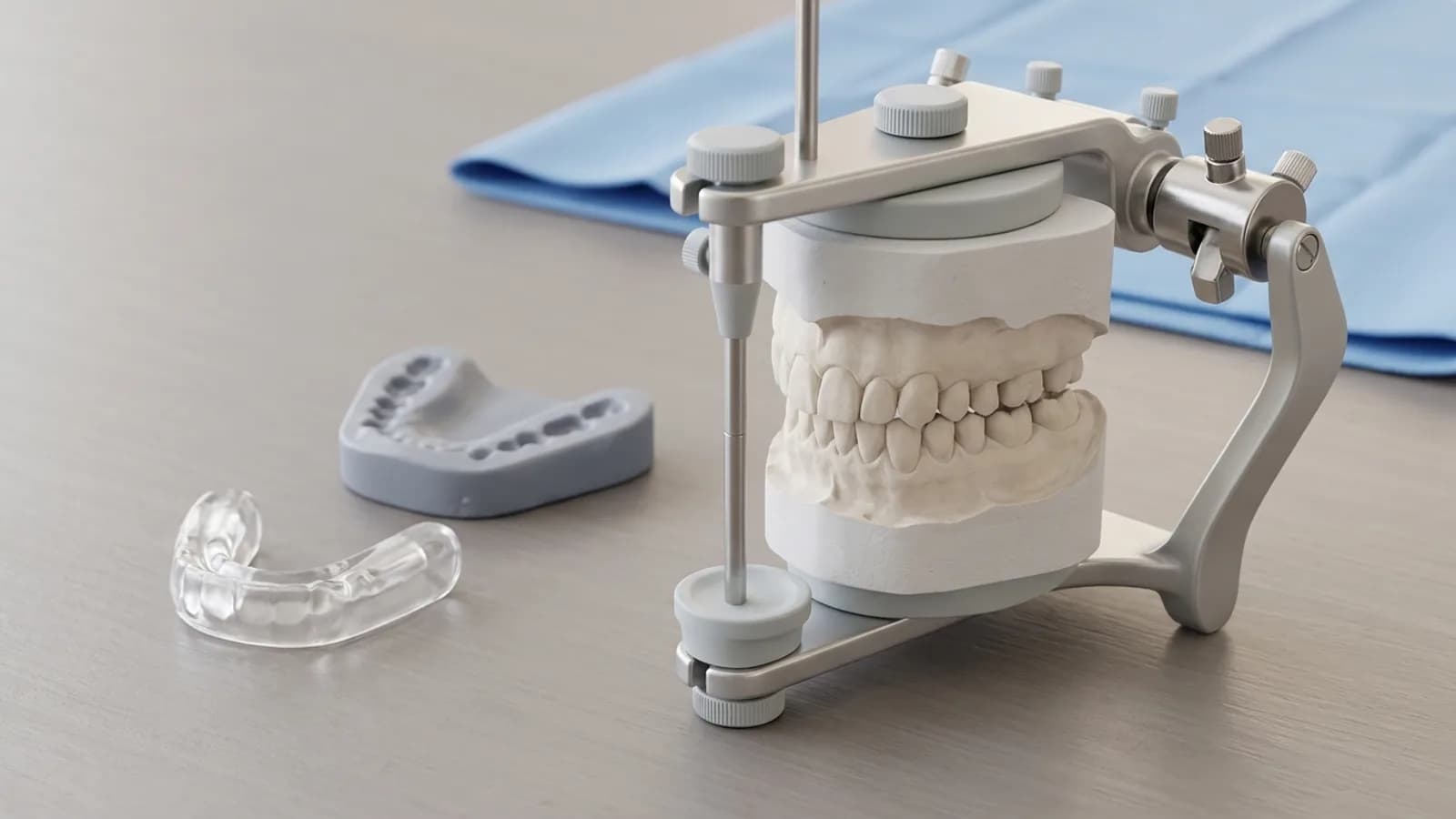
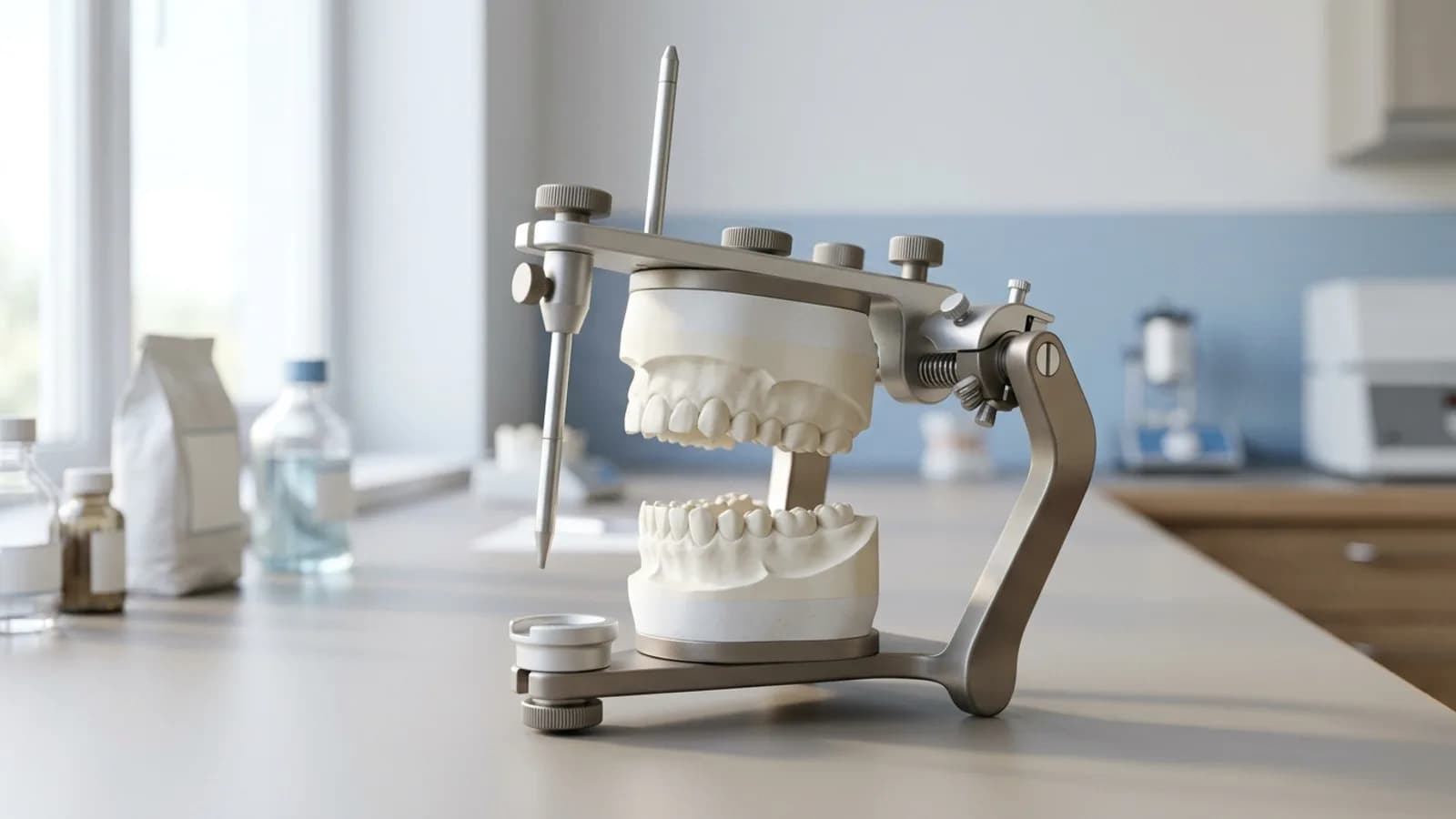
- Articulator geometry. Because the mandible rotates, opening at the incisors is larger than opening in the molar region. Plan on the articulator, where the incisal pin directly shows the anterior change.
Do you need to test the new VDO with a splint?
Testing a new VDO with a removable appliance for weeks or months has long been considered standard. A randomised controlled trial now challenges this for tooth wear patients. Crins et al. (2023) allocated 42 patients with moderate to severe tooth wear either to a test phase with a removable appliance or to no test phase before full composite rehabilitation at an increased VDO. After one year, testing had no effect on oral health-related quality of life or on interventions to the restorations. The authors concluded that a removable appliance is not indicated to functionally test the increased VDO in these patients.
This is consistent with Abduo's finding that adaptation is better with fixed restorations than with removable appliances. The exception is the patient with temporomandibular disorder (TMD): Abduo and Lyons (2012) recommend a removable appliance first to control symptoms before any irreversible procedure. The stabilisation splint used for this is described in our article on occlusal splint therapy.
Localised increase: the Dahl concept
When wear is limited to the anterior teeth, space can be created locally instead of opening the whole bite. Dahl and Krogstad (1985) followed 20 patients after a partial bite-raising appliance and anterior crowns, with an average increase of 1.9 mm, for a mean of 5.5 years. Some relapse occurred, mainly in the first six months, but in no case did the face height return to baseline, and 12 of 19 patients had practically stable vertical relations from 6 to 67 months. Poyser et al. (2005) review how the concept, originally a removable metal bite platform for worn anterior teeth, has since been applied to a wider range of clinical situations while preserving tooth tissue.
Step-by-step: transferring a new VDO
- Diagnose. Record wear, skeletal pattern, overbite and overjet, existing guidance and TMD screening findings. Take photographs and scans as a baseline.
- Treat TMD first if present. Use a reversible splint phase until symptoms are controlled and the jaw position is reproducible.
- Register a stable jaw relation. An anterior jig or leaf gauge provides muscle deprogramming and a vertical stop; see centric relation registration with an anterior jig.
- Plan on the articulator. Set the incisal pin to the planned increase and produce a diagnostic wax-up.
- Check intraorally. A mock-up from the wax-up lets you and the patient assess aesthetics, phonetics and comfort.
- Transfer with transitional restorations. Bonded direct composite, composite onlays or printed interim restorations bring the new VDO into function. Printed materials are for interim use only: Doumit et al. (2025) found more than 0.5 mm of wear in 35% of printed ceramic-reinforced composite restorations after 24 months.
- Refine and confirm. Adjust contacts and guidance, confirm patient adaptation.
- Restore definitively in segments. Keep stable support at the new VDO throughout, so each registration has a reference.
Direct composite placed at an increased VDO has medium-term data: Mehta et al. (2021) reported annual failure rates of up to 2.2% for anterior and 2.9% for posterior restorations after a mean of 62.4 months in 34 patients with severe wear. The full treatment sequence for these patients is described in our article on full mouth rehabilitation of the worn dentition.
Common mistakes
- Measuring instead of planning. Searching for the "lost" millimetres with unreliable methods instead of planning from restorative space and aesthetics.
- Ignoring the skeletal pattern. In Class II patients, a large opening can increase the overjet and make anterior guidance hard to achieve.
- Too much at once in a localised case. Large anterior increases without a plan for posterior contact.
- Skipping TMD screening. Irreversible changes in a patient with active TMD symptoms.
- Forgetting the guidance. A raised bite without functioning anterior guidance overloads the new posterior restorations.
Summary
The vertical dimension of occlusion is a planning tool, not a fixed value to be restored. Increase it when you need restorative space or better anterior aesthetics, keep the increase as small as possible, with up to 5 mm considered justifiable, and transfer it with fixed restorations. A routine splint test is not required in tooth wear patients without TMD. Diagnosis, registration and transfer of a new VDO are practised step by step in our VDO dental training course.
Frequently asked questions
What is the vertical dimension of occlusion?
The vertical dimension of occlusion is the vertical distance between the maxilla and mandible when the teeth are in maximum intercuspation. It is determined by the teeth and their supporting structures and can change with wear, tooth loss or restorations. Current literature regards it as a dimension within a zone of physiological tolerance rather than a fixed value.
How much can the VDO be increased safely?
Abduo and Lyons consider an increase of up to 5 mm justifiable when it is needed for restorative space and anterior aesthetics, while recommending the minimal increase that meets the goal. Systematic reviews report that transient signs and symptoms can occur but are usually self-limiting, and that a permanent VDO increase has not been shown to cause long-lasting TMD symptoms.
How do I know if a patient has lost vertical dimension?
Often you cannot know precisely. The published methods for quantifying VDO loss are inconsistent, and worn teeth frequently over-erupt, which compensates for the lost crown height. Instead of measuring a deficit, assess the restorative space you need, the planned incisal edge position, the facial proportions and the patient's phonetics and comfort with a mock-up.
Is a splint needed before increasing the VDO?
Not routinely. A randomised controlled trial in 42 tooth wear patients found no benefit of testing the increased VDO with a removable appliance before composite rehabilitation. Patients with TMD symptoms are the exception: they should have a reversible splint phase to control symptoms before any irreversible change to the vertical dimension.
What is the Dahl concept?
The Dahl concept creates space locally by placing an appliance or bonded restorations that hold the posterior teeth apart, after which the teeth re-establish contact through a combination of intrusion and eruption. In Dahl and Krogstad's long-term study, an average increase of 1.9 mm did not return to baseline in any patient over a mean of 5.5 years.