3D printing in dentistry has moved from the dental laboratory into the surgery: models, occlusal splints and surgical guides now come straight from the intraoral scan in many practices. Whether an in-house printer pays off depends less on the machine than on your indications, your post-processing discipline and the obligations that come with making devices yourself. This article helps you decide which applications suit your practice, where printed resins fall short according to the evidence, and what EU medical device law expects of a dentist who prints.
How 3D printing in dentistry works: the relevant technologies
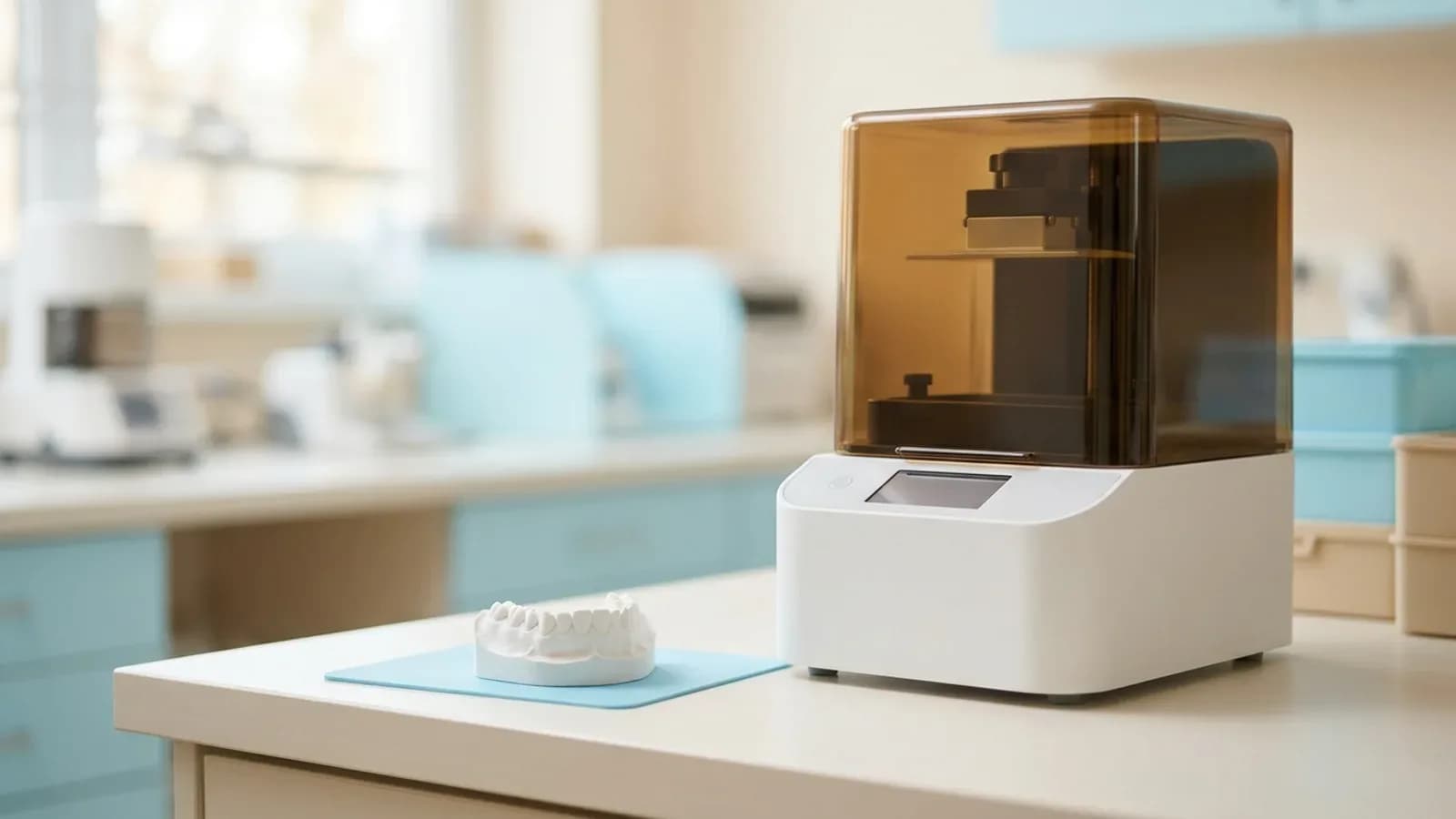
Additive manufacturing is divided into seven process categories. For dental polymers, four matter most: stereolithography (SLA), digital light processing (DLP), material jetting and material extrusion (Revilla-León and Özcan 2019). Widely used in practices and laboratories are vat photopolymerisation machines, SLA or DLP, in which a laser or a projector cures liquid resin layer by layer. In the studies on printed full-arch models, SLA was the most investigated technology, followed by DLP (Etemad-Shahidi et al. 2020).
Three consequences follow in daily use:
- Layered build: printed parts are anisotropic. Orientation on the build platform and layer thickness affect accuracy and strength.
- Support structures: overhangs need supports, which are removed after printing and leave marks.
- Post-processing: a freshly printed part is neither clean nor fully cured. Washing and post-curing are part of manufacturing, not an optional extra.
In an in vitro study on SLA specimens, dimensions along the Z-axis deviated by up to 10 %, specimens printed at 45° were the most accurate, and objects at the edge of the build platform were less accurate than those in the centre (Unkovskiy et al. 2018). For the flexural strength of printed interim materials, the effect of print direction was material dependent and smaller than the effect of ageing (Keßler et al. 2021).
Where an in-house printer pays off
The table summarises common indications and what each depends on. It is no substitute for your own business case.
| Indication | Benefit in practice | What to watch |
|---|---|---|
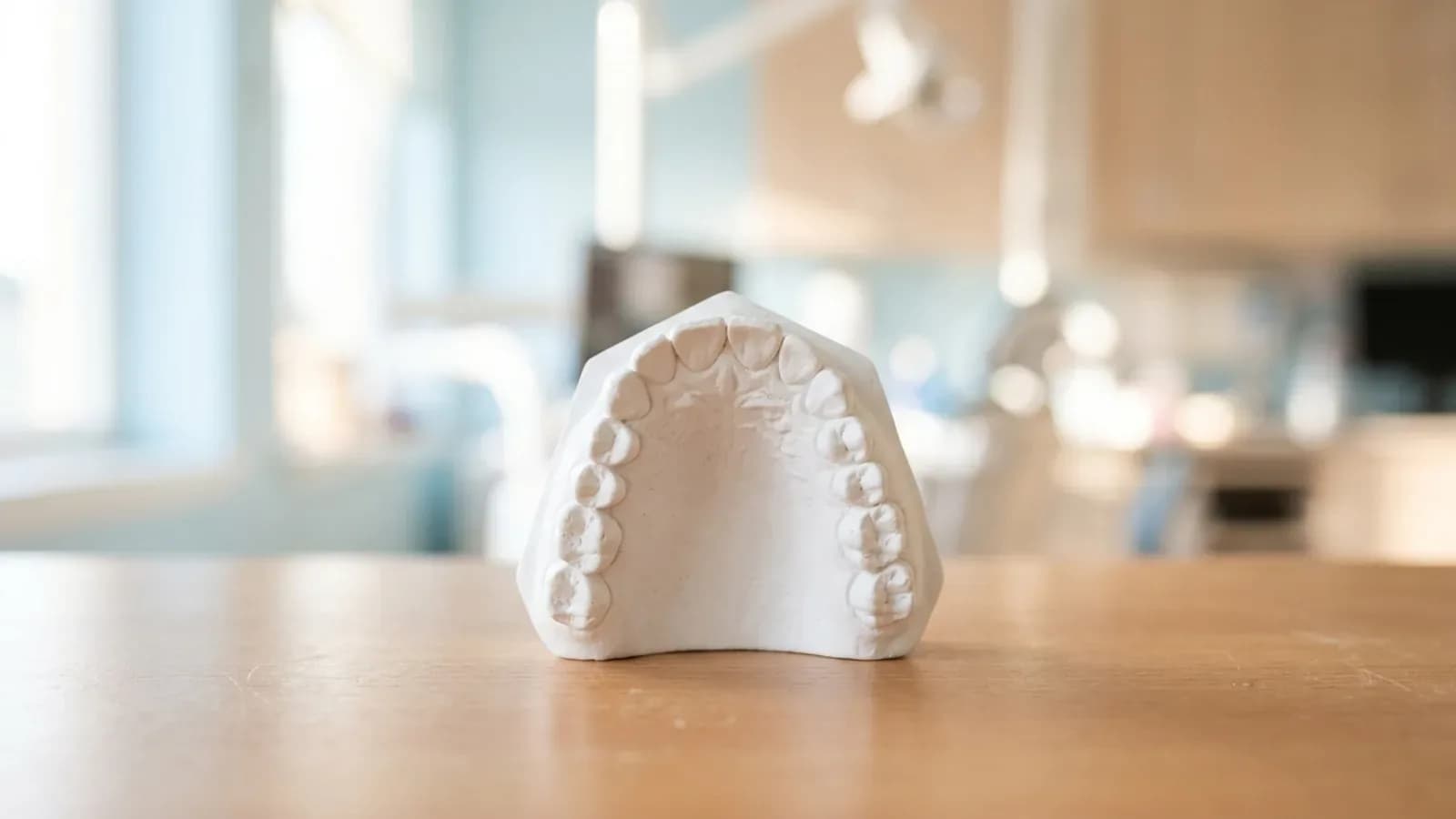
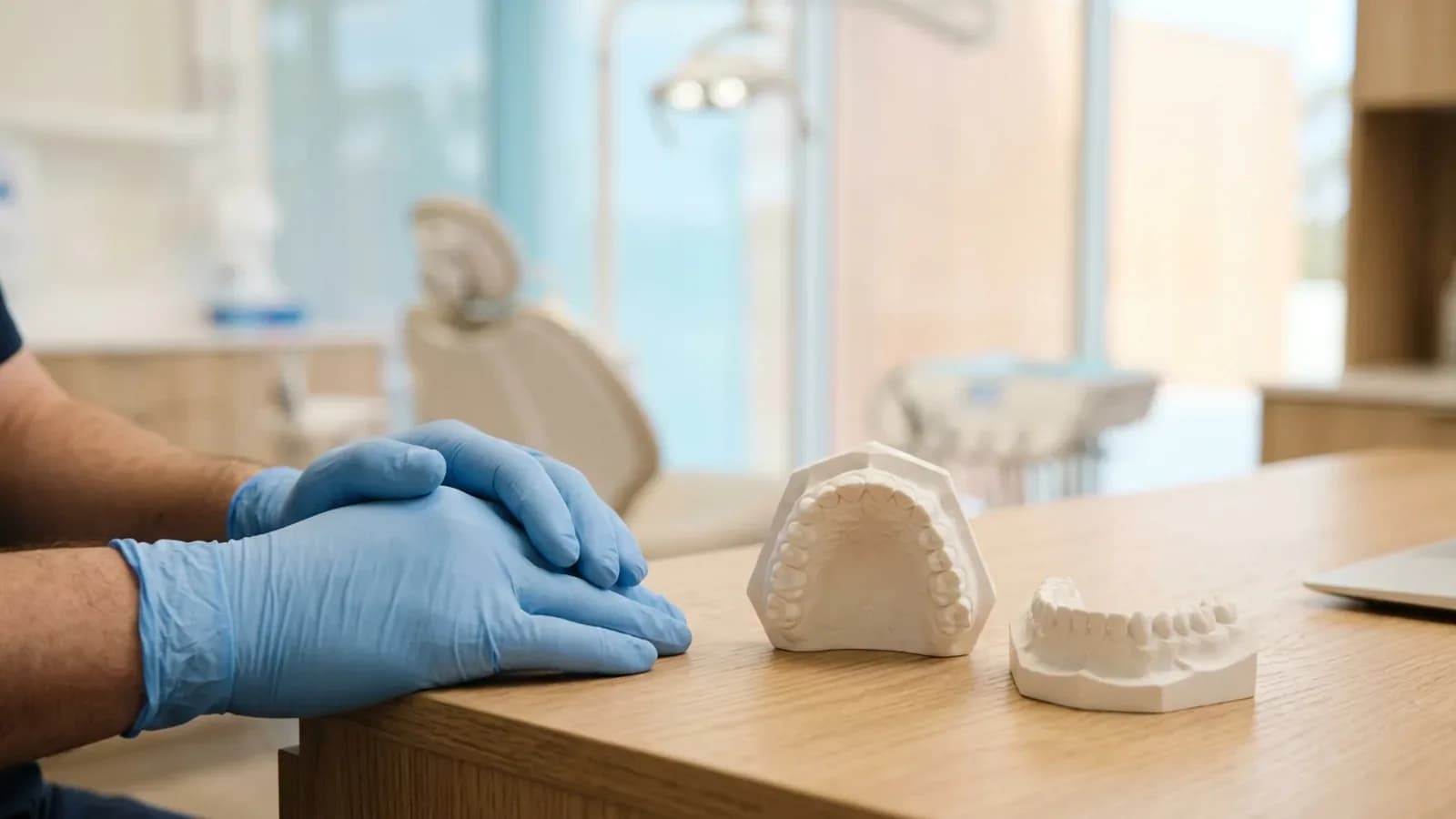
| Study and working models | No stone, quick replacement, model straight from the scan | Accuracy varies widely between printers and settings |
| Models for mock-up matrices | Digital wax-up becomes the model for a clear silicone index | Surface quality in the anterior region |
| Occlusal splints, bleaching trays | Planned, reproducible fabrication from the scan | Material validation, post-curing, checking the fit |
| Surgical guides | Planning and fabrication in one hand | Accuracy of the whole chain, safety margin |
| Interim occlusal onlays (tabletops) | Test a new vertical dimension without removing tooth structure | Wear, limited service time |
| Definitive crowns from printable resin | Treat with caution for long-term use | Long-term clinical data are lacking |
Printed models: the easy start, with traps
Models are the most common application. A systematic review of 28 studies reported accuracies of printed full-arch models from under 100 µm to over 500 µm; most were considered clinically acceptable, and six of the eight DLP printers investigated stayed below 100 µm (Etemad-Shahidi et al. 2020). Layer thickness, base design, post-processing and storage all had a significant influence. The key point for restorative work: a model that is good enough for orthodontic records is not automatically good enough for fixed prosthodontics.
Dr Hajtó lists printed models as a possible cause when a single crown arrives too high. Printing parameters and changes to the model after printing are on his checklist, as is the laboratory failing to adjust the occlusion of the models, which printed models need just as stone models do. A simple test: does the bite registration seat exactly on the printed model? In implant cases he also names the laboratory analogues used in printed models as a source of error.
In aesthetic planning he works with printed models as well: the digital wax-up is printed and used as the template for a clear silicone index, through which the mock-up is made in the mouth. The steps are covered in the article on the diagnostic wax-up and mock-up.
3D printed splints: digital, not effortless
In the digital splint workflow that Dr Hajtó teaches, the bite is taken with a leaf gauge at the planned opening and scanned in that position, followed by design, model printing and printing of the splint. His rule for how far to open: where much vertical dimension has been lost, he works towards the height the future restorations are expected to have. If that would make the splint thicker than the planned vertical dimension, he opens only until the splint runs level over the most distal tooth and reaches a thickness of no less than 1.5 mm there. Indications and design are discussed in the article on occlusal splint therapy.
The evidence on printed splint resins is mixed. Comparing pressed, milled and printed splint materials, one study found baseline flexural strength of 19.5 to 91.3 MPa for the printed resins against 95.1 to 122.0 MPa for the milled ones; after artificial ageing the printed materials dropped to 13.0 to 63.3 MPa, and they showed higher water sorption and solubility (Berli et al. 2020). For fit, milled and injection-moulded splints showed the smallest deviations; printed splints deviated more, though the authors judged them clinically acceptable, with DLP splints deviating most in that investigation (Wesemann et al. 2021). Both studies tested specific materials and machines, so the results cannot be transferred to every system.
A splint that gives, tilts or sits loosely is not finished. In that case Dr Hajtó relines it: sandblast the fitting surface, condition it with Visiolink (bredent), reline with light-curing resin, isolate the teeth with petroleum jelly, give it only a brief initial cure intraorally while excess between the teeth is still flexible, cure it fully outside the mouth, then trim and smooth the borders, reduce the interdental septa slightly and polish.
Surgical guides: the printer is one link in the chain
For static guides, a meta-analysis of 20 clinical studies with 2,238 implants found mean deviations of 1.2 mm at the entry point, 1.4 mm at the apex and 3.5° in angulation, with better accuracy in partially than in fully edentulous patients (Tahmaseb et al. 2018). The authors advise a safety margin of at least 2 mm. These figures describe the clinical outcome of static guides as a whole; fabricating the guide is only one part of it. On the material side, a laboratory study detected twelve different substances eluted from printed guide resins; relative amounts were comparable to conventional direct composites and below toxicologically relevant concentrations, but the absolute amount can rise because guides are large (Kessler et al. 2020).
Interim tabletops: printed, but temporary
For an increase in vertical dimension, Dr Hajtó names 3D printing as one way to make thin occlusal onlays: printed from an interim restorative resin and bonded with composite; alternatives are composite placed directly in the mouth or milled onlays. Two details from his practice: where the support structures are cut off, clearly recognisable marks remain on the surface, which argues for placing supports on less visible areas when orienting the part; and during bonding he protects the neighbouring surfaces with PTFE tape reaching precisely to the occlusal surface, or with a metal matrix. He limits the service time to no more than 6 to 12 months.
The clinical data support that limit. In a study of 28 patients with 352 printed, non-invasive restorations made from a ceramic-reinforced composite resin, molar restorations showed the greatest mean maximum height loss: 0.76 mm after 12 months and 1.25 mm after 24 months. After two years, 35 % of restorations had lost more than 0.5 mm and were classified as fractured (Doumit et al. 2025). The authors consider the material suitable only for interim restorations. How to plan the new jaw relation behind such onlays is covered in the articles on the vertical dimension of occlusion and on full-mouth rehabilitation of the worn dentition.
Hands-on dental courses
Courses for dentists in Munich, several of them taught in English.
See all coursesPost-processing: where printing projects succeed or fail
Whether a printed part reaches the properties stated by the manufacturer is decided after printing. In a study on an interim resin, the choice of post-curing unit had a strong effect on the degree of conversion, followed by layer thickness (Reymus et al. 2019). For a printable denture-tooth resin, a higher post-curing temperature improved both flexural strength and cell viability (Bayarsaikhan et al. 2021).
How specific the requirements are can be seen in the instructions for use of one splint resin (VOCO V-Print splint):
- Design with a minimum wall thickness of 1.5 mm, 3 mm recommended; layer thickness 50, 75 or 100 µm; print on an approved 385 nm DLP printer.
- After printing, allow about 10 minutes for dripping and continue without delay to avoid distortion.
- Clean in isopropanol (at least 98 %) in an unheated ultrasonic bath: 3 minutes pre-cleaning, 2 minutes main cleaning in a fresh bath, then dry.
- Wait 15 minutes after the last contact with isopropanol, protected from direct light.
- Post-cure in one of the listed units, with parts neither touching nor shading each other.
- Use intraorally only when completely cured.
Add occupational safety and housekeeping: the liquid resin can sensitise skin and airways, and the manufacturer recommends nitrile gloves, safety glasses and extraction, plus separate vats and cleaning baths for each material. What counts is always the instructions for use of the specific material with the printer and curing unit approved by its manufacturer.
The regulatory side: you become a custom-made device manufacturer
In the European Union, a practice that prints a splint, a surgical guide or an interim restoration for a particular patient is manufacturing a medical device. The EU Medical Device Regulation (MDR) defines a custom-made device as one made according to the written prescription of an authorised person, with specific design characteristics, for the sole use of a particular patient (Article 2(3)). The guidance document MDCG 2021-3 gives a crown made to a dentist's written prescription as an example and confirms that 3D printing may be used for custom-made devices. A printed device is not custom-made by default, though: the prescription, single-patient use and the absence of mass production must all apply.
Custom-made devices follow the procedure in Article 52(8) and Annex XIII of the MDR. In practice this means:
- a statement according to Annex XIII Section 1, made available to the patient or user and kept for at least 10 years (15 years for implantable devices),
- documentation of design, manufacture and performance of the device (Annex XIII Section 2),
- a quality management system proportionate to the risk class and type of device (Article 10(9)),
- post-market surveillance and reporting of serious incidents,
- according to MDCG 2021-3, a person responsible for regulatory compliance under Article 15; micro and small enterprises need not employ this person in-house but must have them permanently and continuously at their disposal (Article 15(2)).
Custom-made devices do not carry a CE mark. If you use a CE-marked printing resin, you may take its conformity into account, but only if you process it within its intended purpose and according to its instructions (MDCG 2021-3, question 10). An unapproved printer or an improvised curing step therefore undermines not only the material properties but also your documentation. National rules can add requirements, so check with your national competent authority or dental association. Outside the EU, your own national regulator sets the rules.
Does the printer pay for itself? Questions before you buy
There is no reliable break-even figure, because case numbers, indications and staff costs vary too much between practices. Before buying, answer these questions:
- Which indications do you actually see each month, and which of them do you want to make in-house?
- Is every planned material approved for exactly this printer and this curing unit?
- Who designs, prints, washes, post-cures and documents?
- Is there a room with extraction and storage for resins and isopropanol?
- Which work deliberately stays with the commercial laboratory, such as definitive restorations?
Summary
3D printing in dentistry pays off in practice mainly for models, splints, surgical guides and interim restorations; for definitive restorations made from printable resin, solid clinical evidence is still missing. Accuracy and material quality depend on orientation, material choice and, above all, post-processing that follows the manufacturer's instructions, and with the first printed splint you take on the obligations of a custom-made device manufacturer. The course 3D printing in practice with Priv.-Doz. Dr Andreas Keßler covers the digital production process from data acquisition by intraoral scan to a clinically usable product; the hands-on part includes an occlusal splint in a digital workflow, an implant surgical guide, printing a restoration, and post-processing with characterisation by stains.
Frequently asked questions
Which 3D printer is right for a dental practice?
The system matters more than the brand. For every material you plan to use, the resin manufacturer should have approved exactly this printer and this post-curing unit. Vat photopolymerisation printers, SLA and DLP, are widely used in practices. Also check the build platform size, the software, the range of approved materials for splints, models and guides, and the workload of cleaning and maintenance.
Can you print occlusal splints in the practice?
Yes, provided the material, printer and post-curing unit are approved together and the instructions for use are followed. In laboratory studies, printed splint resins had lower flexural strength and higher water sorption than milled ones, while the fit in one study was judged clinically acceptable. Check every splint at delivery: it has to sit stable, without tilting and with adequate retention.
How accurate are 3D printed dental models?
It depends heavily on the printer and its settings. A systematic review found deviations between under 100 µm and over 500 µm, with most models clinically acceptable. Layer thickness, base design, post-processing and storage all affect the result. Working models for fixed prosthodontics demand more accuracy than orthodontic record models, so validate your own system before relying on it.
Do printed tabletops and crowns last long term?
The evidence for long-term use is thin. In a clinical study, printed restorations made from a ceramic-reinforced composite resin showed considerable wear after two years, and about a third were classified as fractured. Dr Hajtó therefore uses printed tabletops only as interim restorations and limits their service time to a maximum of 6 to 12 months.
Am I a manufacturer if I print devices in my practice?
In the EU, yes, if you make a medical device for a particular patient yourself. If it meets the criteria of Article 2(3) MDR, it is a custom-made device, and the Annex XIII procedure with a statement and documentation applies, together with a proportionate quality management system, post-market surveillance and incident reporting. Your national competent authority can answer questions on implementation.